
Why Great Scientists Struggle to Present and How to Fix It
A Guide for PhDs in Pharma and Academia
Scientific expertise and scientific communication are not the same skill. Across pharma companies, research institutes, and universities, even world-class scientists often struggle to present their ideas in a way that resonates outside their immediate field. They are brilliant at generating insights, yet many find it difficult to share those insights in a way that engages cross-functional teams, senior leaders, investors, or collaborators from other disciplines.
The good news: this is not a talent issue. It is a strategy issue and it can be fixed.
This article explains why capable scientists struggle with presentations, and more importantly, how to correct these issues so both scientific and non-scientific audiences stay engaged and excited about your work.

1. The Expertise Trap: When Knowledge Works Against You
The more you know, the harder it becomes to decide what not to include.
Scientists spend years developing deep expertise. Every experiment, parameter, and data point feels meaningful, because in research, it is. However, audiences do not need (or want) the entire dataset. They want clarity, meaning, and direction.
Common patterns:
Slides overloaded with charts, labels, and subfigures
Excessive background information
Long explanations of mechanisms before explaining relevance
Diving into exceptions, caveats, and limitations too early
Why this happens:
You want to be accurate. You don’t want to oversimplify. And you don’t want peers to think you overlooked something.
How to fix it:
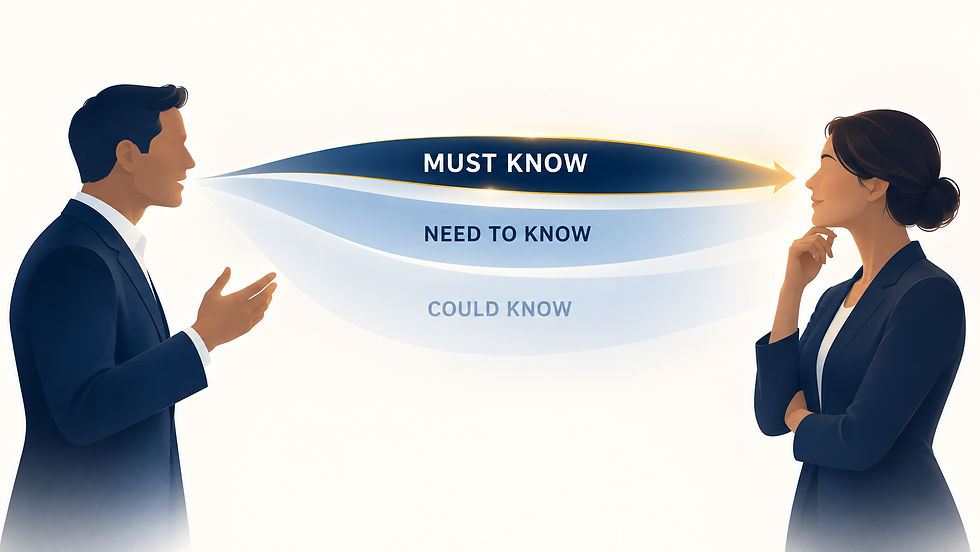
Lead with the strategic message, not the data.
Try this three-step filter:
What does the audience need to understand first? Usually the problem you are solving or the opportunity you are pursuing.
What data directly supports that understanding? Only show the evidence that advances the main point.
What details can move to backup slides? Keep depth available, just don’t let it block your story flow.
Top presenters do not hide complexity; they sequence it.
2. Forgetting the Audience: You’re Presenting to People, Not Protocols
Great science is objective. Great presentations are audience-focused.
The struggle occurs when scientists assume that their audience, even an all-PhD audience, thinks the way they do. In reality, every presentation room contains a mix of backgrounds: clinical, regulatory, manufacturing, executives, investors, or collaborators from entirely different specialties.
Warning signs that the audience has been forgotten:
The presenter defines success as “covering all the information,” not “creating understanding.”
The talk is designed around the structure of the study, not the needs of the listeners.
Important strategic implications appear only at the end, if at all.
The solution:
Start by asking a simple question: “What does this audience care about most?”
For example:
Executives care about risk, timelines, and decision points.
Cross-functional teams care about how your work affects theirs.
Collaborators care about novelty and feasibility.
Investors care about potential, differentiation, and milestones.
Academic audiences care about contribution to the field and clarity of hypothesis.
When you know what the audience values, you can shape the story so they can follow it and be motivated by it.
3. Overloading Slides: The Myth That More Data = More Credibility
Scientists often believe that “more detail” shows rigor. In presentations, the opposite is true.
Slides packed with text, panels, and annotations force the audience to choose between reading and listening. They cannot do both.
What overloaded slides signal to an audience:
The presenter didn’t prioritize key information
The message is unclear
The audience must interpret the data on their own
Cognitive load is too high, causing disengagement
The fix:
Adopt a clean, message-first slide design.
For each slide:
Write a clear headline that states the conclusion, not the topic. Not: “Data from our dose-response study”Instead: “Compound X shows a clear dose-dependent decrease in tumor volume”
Use one key visual or chart per slide. If you need more, split it into multiple slides.
Tell the audience where to look. A simple spoken instruction (“Focus on the blue line—this is the breakthrough”) keeps everyone aligned.
When slides become simpler, your voice becomes the primary storytelling tool, exactly as it should be.
4. Missing the Story: Presentations Are Not Manuscripts
Scientists often build presentations the same way they write papers: background → methods → results → discussion → conclusion.
But audiences do not experience information the same way readers do. Presentations must follow a story arc, not a manuscript structure.
An effective scientific story arc looks like this:
Hook – Why this work matters (problem, unmet need, opportunity).
Tension/Challenge – What made the work difficult or uncertain.
Breakthrough – What new insight or achievement you discovered.
Implication – Why this matters for the audience or field.
Next Step/Call to Action – What you want the audience to do next.
This is how you turn a complex project into a compelling narrative without sacrificing scientific integrity.
5. Not Practicing Transitions: The Glue Between Ideas
Even sophisticated content fails if transitions between sections feel abrupt. Strong presenters guide the audience through the narrative, anticipating questions and removing confusion before it appears.
The problem:
Scientists think deeply about the content, but not enough about the flow.
The fix:
Use transition statements like:
“Now that we understand the challenge, let’s look at how we approached it.”
“This finding raised a critical question…”
“To see the impact of this discovery, we need to examine…”
“Let me connect this to the clinical relevance.”
Transitions help the audience stay grounded—even in a complex presentation.
6. The Core Skill: Connection Beats Complexity
The best scientific presenters share one trait: they connect with their audience before they dive into content. They communicate with empathy, presence, and intention.
Great presenters:
Make eye contact
Read the room
Adjust pace and depth based on audience response
Frame content in a language the audience understands
Treat the presentation as a conversation, not a lecture
Scientific excellence creates the content. Audience connection creates the impact.
Final Thought: Clarity Is Not Simplification - It Is Amplification
Scientists do not need to lower the quality of their work to communicate well. The goal is not to “dumb down” the science. The goal is to make your insights accessible enough that people can act on them.
When you simplify messaging, focus on the audience, use story structure, and design slides that highlight the essential points, your presentations do more than inform, they persuade, align, and inspire.
In pharma, biotech, and academia, that is not a soft skill. It is a strategic advantage.


Comments