
How Closing the Communication Gap Opens the Room
Updated: 4 days ago
This article is part three in a series of three articles on this topic. To start with article one, click here.
Six weeks after the board meeting that had gone quiet on her, Priya's CSO stopped by her desk with a request that would have terrified her a month earlier: leadership was presenting to the investment committee ahead of a Series C conversation, and they wanted her on the agenda alongside them, covering her program. Five minutes, plus whatever questions came her way. A room of people who had never heard of her, deciding in real time whether her work was worth the next round of capital.
The old Priya would have started building a twenty-slide deck that night. This time, she opened a blank page and wrote one line first: what does this room need to walk away knowing?

Building the five minutes backward
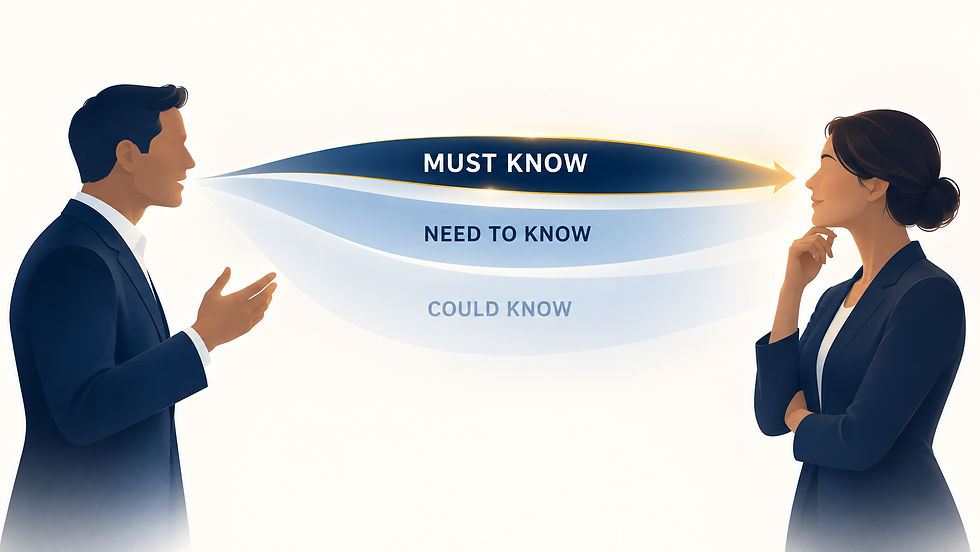
She started with Layer 1, and she started ruthlessly. Not "we've made progress on the target engagement assay": that was true, but it wasn't the message. The message was: this program is de-risked enough to justify the next round, and here's the milestone it unlocks. One sentence. She said it out loud to herself a dozen times before it stopped sounding like a summary and started sounding like a decision.
Layer 2 came next, and this time the question wasn't what do I know but what does this specific room need to trust Layer 1 without needing to be walked through the reasoning. Three points, no more: the assay result that mattered, the timeline it protected, and the one risk she knew someone in that room would ask about anyway, so she got there first, on her terms, before it looked like something she was hiding.
Everything else, the alternative targets she'd ruled out, the six months of failed assay conditions before the one that worked, the full statistical breakdown, went into Layer 3. Not deleted. Organized, tabbed, and ready. She built four backup slides she fully expected never to show.
She rehearsed the five minutes until it felt almost too short. That discomfort, she recognized now, was the same discomfort from the coach's training: the instinct that brevity meant she was leaving something out that mattered. She'd learned, slowly, that the instinct was measuring the wrong thing. It was built for a room that needed her to prove her thoroughness. This was a different room.
The room that leaned in
She led with the sentence. This program is de-risked enough to justify the next round, and here's the milestone it unlocks. Then she moved into Layer 2: the assay result, the timeline it protected, the one risk she'd decided to name before anyone else could. She delivered all three with the same authority she used with her research colleagues, no hedging, no "we believe" softening the finding into a maybe. It didn't take five minutes. It took under three. And then she stopped, no trailing addendum, no "and just to be thorough." She let the silence sit, and let the room decide what it wanted next.
Nobody checked a phone. When the questions came, they came straight for the two places she'd expected them to: a partner from the investment committee asked about the exact risk she'd already named in Layer 2, and she answered in two sentences, because she'd already decided what mattered before he asked. When a second question reached for something deeper (the statistical detail behind one of her results), she pulled up the matching backup slide without missing a beat, walked through it in a few sentences, and stopped talking. She didn't narrate her way back through the methodology to justify it. She let the slide speak, then waited.
Afterward, her CSO told her something that stuck harder than any praise about the science itself: "That's the first time I've watched you run a room instead of survive one."
What actually changed
The science Priya presented to the investment committee wasn't better than the science she'd presented to the board six weeks earlier. It was, if anything, less complete: fewer caveats, fewer methodological digressions, less of the texture that had made her feel, in the old framework, like she was doing her job well.
What changed was the equation underneath it. She had spent a decade believing that more detail signaled more rigor, and that leaving anything out was a kind of intellectual dishonesty. What she'd learned, first in the wreckage of the board meeting, then in the coach's training, then in the five minutes that didn't feel long enough, was that the room in front of her wasn't grading her thoroughness. It was deciding what to do next, and her job was to make that decision easy.
That shift didn't cost her any credibility. It's what earned her more of it. She left that meeting having said less than she knew, and having been trusted more than she ever had been in a room like that. The gap hadn't closed because she learned to perform confidence she didn't feel. It closed because she finally understood which question the room was actually asking, and stopped answering the one nobody had.
______________
Priya's story is a composite, but the pattern behind it isn't rare: it shows up in nearly every technically brilliant scientist stepping into a leadership-facing role for the first time. At BECC Consulting, we've spent nearly two decades helping scientists and physicians close this exact gap: turning deep technical credibility into the concise, confident communication that boards, investors, and executive teams actually need. If this series sounds familiar (in your own experience, or in someone on your team), get in touch to talk about what closing that gap could look like for your organization.


Comments