
The Communication Style Gap Nobody Trains For
Updated: 4 days ago
Dr. Priya Nair has been in the United States for eleven years. She did her PhD at a research university in the Midwest, spent four years in a postdoc lab publishing steadily in well-regarded journals, and joined a mid-sized biotech in the Bay Area three years ago as a senior scientist. Her science is not in question. Her manager calls her one of the sharpest minds on the team. Her data holds up under scrutiny every time.
And yet, every quarter, when it's time to walk the leadership team through her program's progress, something changes. With colleagues (fellow scientists working the same problem), detail is welcome. They ask follow-up questions, want to see the data, and expect her to walk through how she got there. She's in her element.

In front of the Chief Scientific Officer, the CFO, and a visiting board member, the expectations flip: they need the information delivered concisely, and delivered with enough confidence that they trust it's correct without re-deriving it themselves. In that room, she becomes someone else, careful to the point of disappearing. She opens with methodology. She qualifies every claim. She waits to be asked the bottom-line question rather than leading with it. The room, polite but pressed for time, starts to check phones.
Nobody in that room doubts her competence. But competence was never actually what was being evaluated. What was being evaluated (quietly, and almost entirely outside anyone's awareness) was whether she was ready for more: more airtime with the board, more autonomy over her program, the kind of visibility that turns into sponsorship when the next promotion or funding decision comes up.
A gap with a name
This is not a confidence problem, and it is not a language problem in the way people usually mean it. Priya's English is excellent. What she is navigating is a communication style gap: the distance between the norms she was trained in and the norms she is now expected to perform in, often without ever being told the rules changed.
Academic and technical training rewards a specific communication style. Lead with method. Show your work before your conclusion. Hedge appropriately: certainty is a red flag in peer review, not a strength. Let the data speak, and let the audience draw the conclusion themselves.
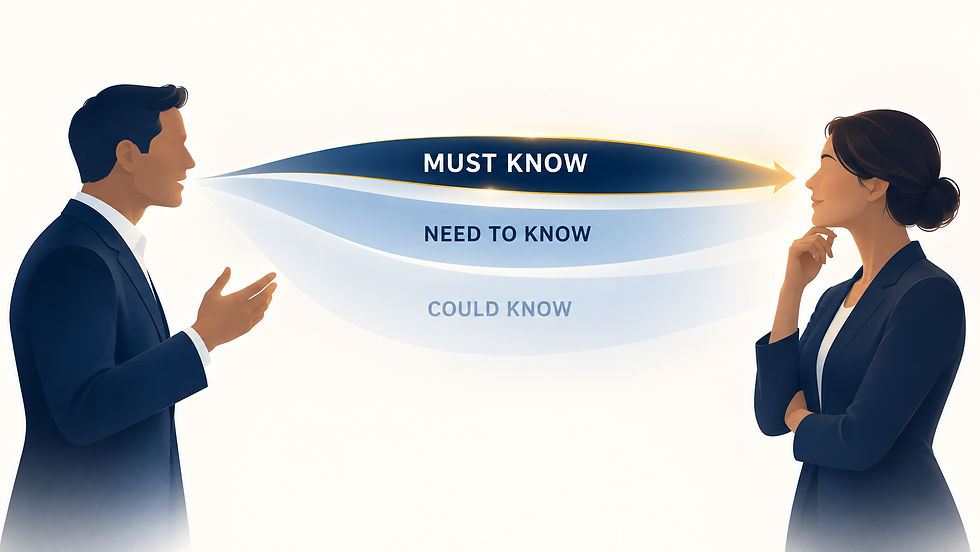
Corporate leadership and investor communication rewards the opposite. Lead with the conclusion. State it with more certainty than the hedge-trained instinct is comfortable with. Compress the "how" and expand the "so what." Treat the audience's attention as the scarcest resource in the room, not the last thing to be addressed once the science is fully laid out.
Almost nobody trains scientists in this second style. Organizations assume it will simply develop on its own, a byproduct of enough time in the room, enough presentations given, enough exposure to how executives talk. It doesn't work that way. It's a learned professional dialect, and like any dialect, this communication style takes deliberate practice, not just time in the country or years in the seat.
Where this shows up first
This piece follows a thread we've written about before. A 2025 study in the Journal of Clinical Oncology found that North American presenters accounted for 69.7% of oral presentations at ASCO Annual Meetings from 2021 to 2024, despite Asia running roughly half of the world's clinical trials. We called that the podium gap: extraordinary research, underrepresented at the microphone.
The uncomfortable follow-on question is what happens to that same research talent once it's hired by a Western company rather than presenting to one. The podium gap doesn't end at the conference stage. It walks in the front door with every scientist recruited into a US biotech or pharma organization straight out of an academic training ground (from Asia or not), and it shows up in smaller, more consequential rooms: the quarterly leadership review, the board update, the investor call, the cross-functional meeting where a program needs a champion who can hold the room.
These rooms don't publish acceptance rates. But the outcomes are just as real. Programs led by scientists who haven't yet found their footing in this style take longer to get funded, are harder to staff, and produce leaders who get passed over for the people-management and cross-functional roles their scientific judgment has clearly earned.
The cost nobody puts in a slide deck
None of this is about ability, and it is rarely about the individual failing to try. It's about a mismatch between where someone was trained to put the emphasis and where a US executive audience expects to find it. Left unaddressed, that mismatch quietly compounds. A scientist who reads as uncertain in front of the board once will be invited back less. Invited back less, she gets fewer reps in that room. Fewer reps, and the gap doesn't close: it widens.
Multiply Dr. Nair by every technically brilliant, academia-trained scientist now working inside a Western biotech or pharma company, and the pattern becomes a talent pipeline problem hiding in plain sight: organizations that recruited for scientific excellence, built almost no bridge to help that excellence land with the audiences who decide what gets funded, promoted, and heard, and then wonder why so much of their strongest technical talent tops out before reaching the leadership table.
What closes it
The gap closes the same way any professional dialect gets learned: not through more time in the country, and not through generic public-speaking tips, but through structured, deliberate practice in the specific style the room actually rewards: leading with conclusions, compressing method, projecting appropriate certainty, and reading a non-technical audience in real time.
Priya's science was never the problem. The question her organization hasn't asked yet is how many other Priyas are in the building, and what it would take to make sure the room hears them the way it hears everyone else.
__________
At BECC Consulting, we've spent nearly two decades helping brilliant scientists and physicians close exactly this gap: translating deep technical expertise into the concise, confident communication style that leadership, investors, and boards expect. Are you interested in how Priya solved her communication hurdle? Click here for Part 2 of this series →


Comments