
The Three Layers Executives Actually Listen To
Updated: 4 days ago
This article is part two in a series of three articles on this topic. To read article one click here.
Dr. Priya Nair replayed the board meeting for three days.
Not the science: the science had been solid, and she knew it. What she kept replaying was the moment, four minutes into her update, when the CFO glanced at his phone. Then the board member. Then, worst of all, her own CSO (the person who had brought her into that room in the first place) started nodding in the particular way people nod when they've stopped listening and are waiting for a natural place to interrupt.
She hadn't said anything wrong. That was the part that gnawed at her. Every sentence had been accurate. Every method had been sound. So why had the room left knowing less about what she needed from them than when she'd walked in?
The question she'd never had to ask
In academia, Priya had been trained, explicitly and relentlessly, to answer one question above all others: how do you know you're right? Committee meetings, thesis defenses, journal peer review: all of it built around the assumption that the audience's job was to find the hole in your reasoning, and your job was to have already closed it. Thoroughness wasn't a nice-to-have. It was the entire currency of credibility.
Nobody in her PhD program had ever asked her a different question: what does this person, in this room, actually need to walk away with?
That question doesn't come up in academic training because academic audiences don't need it answered: professors and committee members already know why they're in the room, and their job is to interrogate, not to act. A board member's job is the opposite. He isn't there to find the hole in her methodology. He's there to decide whether to release the next round of funding, and he has eleven minutes and three other departments after her. He doesn't want to know how she got there. He wants to know where "there" is, and what he needs to do about it.
Priya wasn't failing to communicate. She was answering a question nobody in that room had asked.
Three layers, one message
The reframe came from a coaching conversation. Priya walked through the same update she'd given the board, in full, while the coach listened without interrupting. When she finished, and after some discussion about what in the update was most important, he asked her to give it again, this time in thirty seconds. She did, cutting hard. Then he asked for it again, in fifteen.
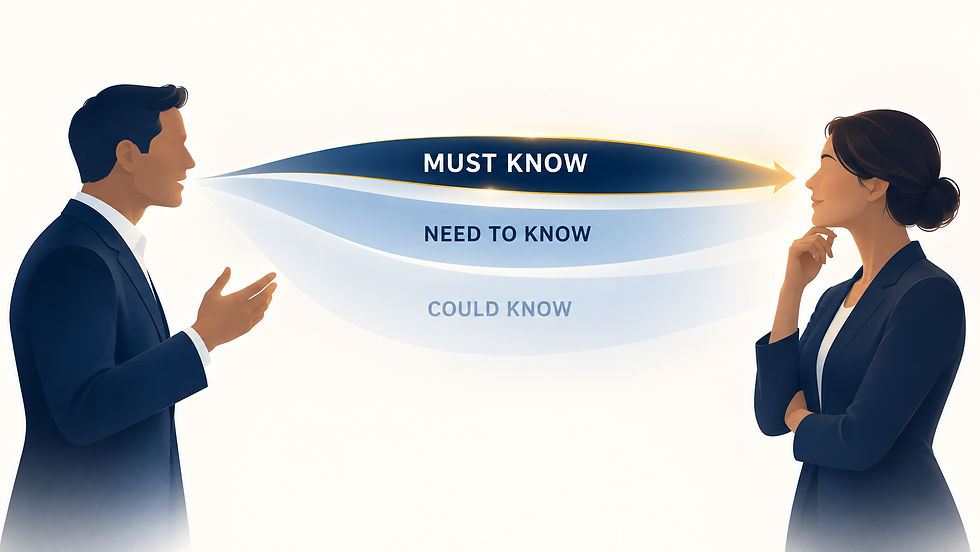
The fifteen-second version was rough: she stumbled, backtracked, cut things that felt essential and immediately worried she'd cut the wrong things. But the exercise held, and out of it came a structure she now uses before walking into any room with people above her pay grade: three layers, sorted not by importance to the science, but by what the listener needs and when:
Layer 1: Must know. The single message the listener needs to walk away with, even if they remember nothing else. Not the finding: the implication of the finding. Not "the assay showed a 40% improvement in target engagement," but "we're on track, and I need approval to move to the next phase by Q3." Getting the words right isn't enough on its own, either. Layer 1 has to be delivered with authority: stated plainly, without a qualifier hedging it into a maybe.
Layer 2: Need to know. The one to three supporting points that make Layer 1 credible without requiring it. Enough for a board member to trust the Layer 1 message, not enough to make him do the work of verifying it himself. This is usually the hardest layer to build, because it requires Priya to ask, ruthlessly, does this help them decide, or does it just help me explain? If it's the second one, it doesn't belong here, no matter how scientifically interesting it is.
Layer 3: Could know. Everything else. The methodology, the edge cases, the alternative hypotheses she ruled out: all of it stays ready, not discarded. If someone asks, she has it instantly. But she doesn't lead with it, and she doesn't volunteer it unprompted. Layer 3 is a resource to be pulled during Q&A, not part of a script to be delivered.
The mindset underneath the framework
The layers are a tool, but the harder shift was underneath them. Priya had been operating, without ever naming it, on an equation she'd absorbed over a decade of training in academia: more detail equals more credibility. Leaving something out felt like cutting a corner, like handing in incomplete work.
The mindset shift was realizing that in front of an executive audience, the equation flips. Volunteering Layer 3 unprompted doesn't read as rigor. It reads as an inability to judge what matters, which is, ironically, the opposite of what she was trying to prove. Trusting the room to ask for more if they want it isn't a concession. It's the more senior move. It signals she already knows the answer to the question that matters most in that room: what does this person need from me right now?
That reframe didn't come naturally, and it didn't come immediately. Priya's first few attempts at Layer 1 were still, in the coach's words, "a very concise version of everything": three sentences trying to do the job of one. Learning to cut wasn't a communication skill so much as a confidence one: trusting that a board member who wants Layer 2 will ask for it, and that being asked is not a failure of her original answer. Organizing the layers correctly turned out to be only half the work. Saying Layer 1 out loud with real authority, rather than easing into it, was the other half.
She had one more high-stakes room coming up, bigger than the last one. This time, she'd walk in with the layers already built.
_____________
At BECC Consulting, this layered approach to executive communication is central to how we coach scientists and physicians moving into leadership-facing roles. Want to see how Priya used it when the stakes were even higher? Click here for Part 3 of this series →


Comments